
Before we had names, we had dreams
The Manifesto
I. The Unmooring
Something has gone quiet in us. Not the noise — the noise has never been louder. Not the capability — we have more tools, more access, more connectivity than any people who have ever lived. What has gone quiet is something older. Something that used to tell us where we were, what we were for, and what the work of our hands was building toward.
We have called this a meaning crisis. That name was too small. It is a formation crisis — the quiet collapse of everything that used to shape a person before information ever reached them. A child raised only on information becomes very good at retrieving answers and has no idea what to do with a life.
Formation comes first. It always has. Before a child can be taught anything true, they must be formed to receive truth at all — to wait, to notice, to be patient with what does not resolve quickly, to hold a tension without demanding it collapse. This is not a new insight. It is what every catechumen has always known, and every farmer has always practiced, and every craftsman has always been taught by the failure of his own hands.
Most of our institutions responded to the quiet by adding programs. More initiatives. More interventions. More frameworks layered on top of frameworks. All well-intentioned. Many effective in isolation. But taken together, they have the quality of furniture rearranged in a house whose foundation is cracking.
What we need is not another program. What we need is a story we can stand inside — and people who have already been formed by one, willing to hand it on.
Before we had names, we had dreams. Some of those dreams became what we did, and what we did named us as who we were. It gave us our last names.
The Millers. The Coopers. The Weavers. The Smiths.
Every surname a function. Every function a thread in the fabric of a village that held together because each person's work made the next person's work possible. The smallest and most complete unit of human civilization — not a nation, not an empire, but a village where every role was necessary and everyone could see how the roles fit together.
The butcher, the baker, the candlestick maker.
We remember it as a nursery rhyme. We have forgotten that it was once a complete picture of how a civilization fed itself, lit itself, and kept itself alive through winter. Each trade existed so the others could exist. The concert required every instrument.
We lost the names when we lost the roles. We lost the roles when we decided that the work of human hands was a problem to be automated rather than a practice to be honored. And when the work went, something else went with it: the experience of being genuinely necessary. Of belonging not because someone declared your value, but because without your hands, something real would go undone.
II. What Was Lost
For most of human history, people knew where they stood.
They stood in a particular place, with a particular soil beneath their feet and a particular sky above their heads. They knew which stars rose when the planting season came. They knew the names of the people who had worked this ground before them, and they had some sense — however imperfect — of the people who would work it after.
This is not nostalgia. The past was brutal in ways we rightly do not wish to recover. But something was carried inside those arrangements that we have not successfully replaced: the experience of being located. Of being necessary. Of belonging not because someone declared your value, but because your hands were in something real that would have gone undone without you.
Belonging does not emerge from being seen. It emerges from being needed.
We have spent decades building cultures organized around expression — around the idea that if people could articulate themselves fully enough, visibility would become belonging. The intent was right. The result was not. When expression is untethered from obligation and contribution, it does not produce freedom. It produces isolation. People become more visible and more alone at the same time.
We confused the symptom for the cure.
III. The Pattern That Holds
There is a pattern in human life that has survived every disruption, every migration, every collapse and reconstruction that history records. It is not complicated. It does not require a new vocabulary.
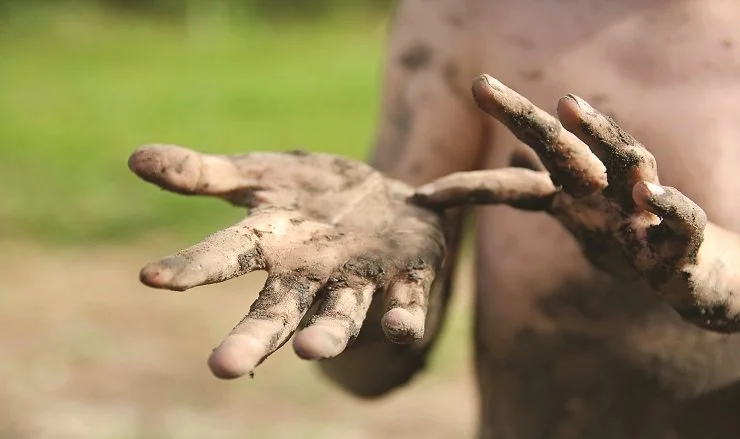
Hands in the dirt. Eyes to the sky.
That is it. That is the whole of it.
Every civilization that endured long enough to build something worth remembering understood this dual orientation. The farmer who plants a seed is making a wager on the future — an act of profound hope, rooted in the particular chemistry of a particular soil, timed to the turning of a particular constellation. The navigator who steers by the stars is grounded in the need to arrive somewhere real, to feed someone real, to return.
Even the ambition that reaches furthest outward — the astronaut who trains for years to leave the earth — is, at root, doing the same thing: learning the conditions of a new place, carrying the knowledge of the old, prepared to tend and be tended in return. Ambition that forgets it must come home again is not formation. It is escape wearing formation's clothes.
Story. Craft. Soil. Sky.
These are not four separate things. They are one arc, seen from four angles. The work of the hand that plants is the same work as the mind that navigates, is the same work as the voice that remembers, is the same work as the will that reaches upward toward what does not move. They have always belonged together. We are the ones who separated them, and we are the ones who can restore the connection.
A seed does not know your politics. A fire does not care about your tribe. A star has been navigating people home for ten thousand years without asking who they voted for. These are the things we did before we had names for what separated us. Seeds to Stars attaches identity to these four things deliberately. Not to avoid the hard conversations, but because belonging to the soil and the sky is a membership nobody can revoke and nobody can be denied. We are not inventing a new neutral ground. We are returning to the oldest one.
We arrived. We built a world where most daily survival is no longer the consuming work of every waking hour — and in the getting here, we put down some things we didn't mean to put down. Seeds to Stars is the coming back. Not after the fracture widens. Now, while the house is still standing.
IV. The Pattern Fulfilled
Every tradition that has ever taken formation seriously eventually asks the same question this manifesto has been circling: formed toward what? Soil, Craft, Story, and Sky are directions, not a destination. A person can be patient, skilled, rooted, and oriented toward the stars, and still be formed toward nothing at all.
We do not think that question is open. Seeds to Stars stands inside the Orthodox Christian tradition — the same faith that has always insisted the material world is not an obstacle to the spiritual life but its very workshop. Christ did not come to rescue people from matter. He took on flesh, worked with his hands at a bench in Nazareth, and was buried in the actual ground before rising from it. The dirt under a child's fingernails in a garden bed is not a distraction from formation. In this tradition, it has always been formation's raw material.
This is not a new claim invented for a curriculum. In the seventh century, at the double monastery of Whitby, an illiterate cowherd named Caedmon tended animals his whole life with nothing to show for it — no learning, no standing, no words anyone thought to record. He was, by every measure available to his own time, unformed. Then, in a vision, he was given a song, and became the first named poet of the English language, father of a whole tradition of sacred verse that followed him. Abbess Hilda, who ran that monastery and hosted the synod that shaped the English church, did not discover Caedmon's gift by testing him. She recognized it because she had already spent a life discerning what God does with ordinary, unformed things when they are finally given to Him.
Wallrath in his clay pit. Caedmon among his cattle. A student with soil under her nails, waiting on a brick to cure. It is the same pattern every time: unnamed hands, ordinary labor, and a formation that was happening long before anyone had the words to explain it.
That is what Sky is actually navigation toward. Not a planet. Not an abstraction called “purpose.” A Kingdom that formation is preparation for entering — the realm every catechumen is being prepared for from the moment they are formed to wait, to notice, and to hold a tension without demanding it resolve.
V. What Seeds to Stars Is
Seeds to Stars is a framework, and it is more than a framework. It is a shared horizon — one that can be adapted locally, respected culturally, and lived out by real people in real parishes and real homeschools without flattening the difference that makes each place worth caring about.
It begins where all real formation begins: with contact. With a seed in the hand. With soil that has its own chemistry, its own history, its own requirements. You cannot fake your way through a garden. The ground will tell you the truth about what you have given it.
From that contact, it extends outward — through the dignity of craft, through the weight of story, through the long-horizon thinking that builds cathedrals for people not yet born — until it reaches the sky. Not as escape. Not as fantasy. As navigation — the ancient and continuing practice of locating yourself by what does not move, so you know which way to go, and what you are being prepared for.
We are not building toward another planet. We are building toward people — people formed enough to be trusted with whatever comes next, on this earth or beyond it. That is the realm this curriculum is actually preparing anyone for.
Seeds to Stars does not replace what already exists. It provides the connective tissue that helps disparate efforts recognize themselves as parts of a single human project — one that was never really secular to begin with, and does not need to pretend to be now.
The framework has guardrails because guardrails are what allow it to travel: no political capture, no ideological sorting, no moral performance, no abstraction without contact with the real. Soil does not recognize political affiliation. Stars do not bend to preference.
This is for everyone who works with their hands. Everyone who teaches. Everyone who plants something knowing they may not be there for the harvest. Everyone who has ever looked up at the night sky and felt, underneath the wonder, a question that would not quiet itself.
VI. What This Asks of You
If you are a student:
You are not here to be filled with content. You are here to be oriented. To find out what you are responsible for that is not about you. Plant something. Build something. Learn the name of the star that told your ancestors when to plant the same crop. Let the gap between those two facts become a question you carry for the rest of your life.
If you are a teacher:
You already know that the most important thing you do cannot be measured on a rubric. You know the difference between a student who has absorbed information and a student who has been changed by an encounter with something real. Seeds to Stars is an invitation to let that knowledge guide the architecture of your work — not to replace what you do, but to give it a name and a home in a larger story.
If you are a funder or a builder:
The meaning crisis is not a niche concern. It is the condition that underlies the erosion of trust, the decay of institutions, the fragmentation that makes every other problem harder to solve. What Seeds to Stars offers is not a silver bullet. It is a sustained, disciplined, culturally grounded effort to restore narrative continuity to the lives of young people at the moment when they need it most. That is worth funding. That is worth building.
Seeds to Stars insists on a direction. Not a destination — the future is genuinely unknown, and anyone who claims otherwise is selling something. But a direction: toward the real, toward the grounded, toward the long-horizon, toward the shared. Toward community built rather than declared. Toward the kind of education that produces not just capable people, but oriented ones — people who know where they stand, what they are part of, and what they owe to those who come after them.

Soil- Grounded Reality
“contact with something real - the ground tells you the truth about what you’re giving it.”
CRAFT- Dignity in work
“the hand that shapes, and shapes responsibly.”
STORY- SHARED MEANING
“the voice that remembers.”
SKY- FUTURE
“not escape. Navigation - locating yourself by what does not move.”